
Photovoltaics with high self-consumption: 78 % in Löhne
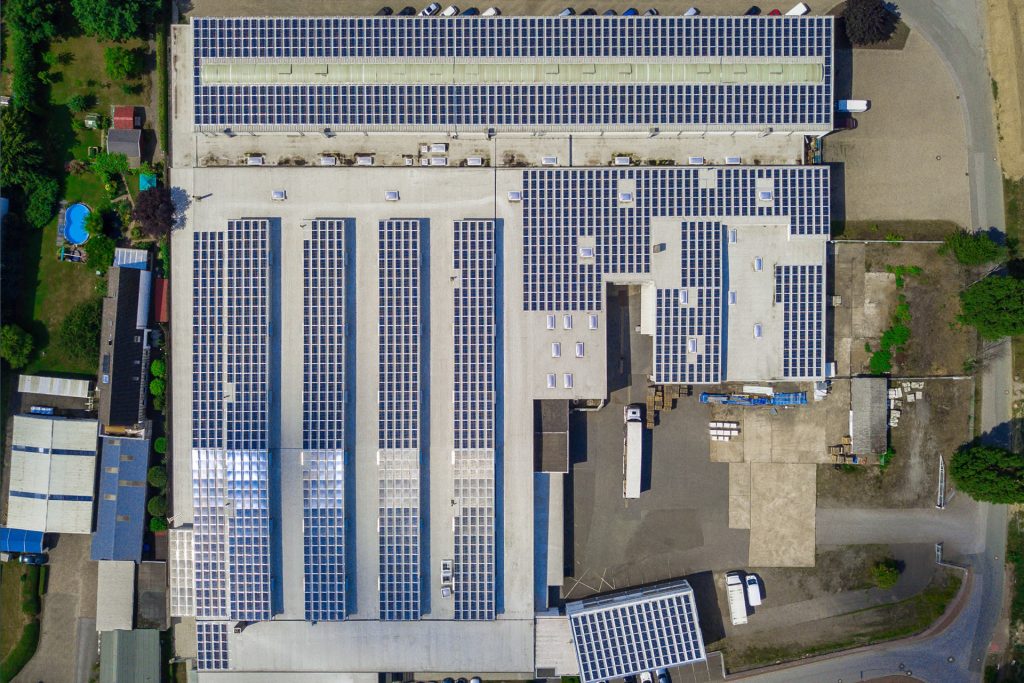
Photovoltaics with high self-consumption is not created by size, but by the correct design. On the roof of a packaging company in Löhne-Gohfeld stand two photovoltaic systems with a total of 716.94 kWp – both at the May 31, 2019 put into operation, but with a completely different task.
The smaller of the two is specifically tailored to operation: It is designed to be used in 180,589 kWh of projected annual production are only 40,000 kWh for the feed-in provided. The rest – approximately 78 % – goes directly into production.
Project at a glance
- 716.94 kWp total power from two plants
- 198.45 kWp self-consumption system with 630 modules
- 518.49 kWp full-load power generation system with 1,646 modules
- 2,276 modules JA Solar JAM-60S01
- 11 Inverters Sungrow
- Commissioning of both plants on 31.05.2019
- Forecast: around 78 kWh of self- % consumption at the self-consumption system
What photovoltaic systems require high self-consumption
A packaging company operates on a continuous basis with consistent power consumption – ideal for photovoltaic systems. At the same time, the available roof area was significantly larger than what the company itself could consume.
If a single large facility had been built, most of the electricity would have gone into the grid for feed-in tariffs – and the benefit from self-consumption would have decreased on average.
Technical solution
Instead, two separate facilities were built:
The self-consumption system with 198.45 kWp is designed so that its production almost completely takes place during operation. From 630 modules, it is forecast that 180,589 kWh will be generated annually, of which only 40,000 kWh are to be fed into the grid. This system saves on electricity bills – and that is the most valuable euro in every PV bill.
The solar power system with 518.49 kWp uses the remaining roof area with 1,646 modules and fully feeds its projected 470,000 kWh.
Both systems are powered by 11 Sungrow inverters: ten SG60KTL-V142 and one SG36KTL. The power reduction is achieved via a rotary controller receiver, as is required for systems over 100 kW.
This results in photovoltaic systems with high self-consumption rates.
The crucial step was not in the technology, but in the sizing: How large can the self-consumption system be at most, so that its electricity actually remains on during operation? This question is answered from the load flow, not from the roof area.
In Löhne, the answer was just under 200 kWp. Anything above that would have reduced the self-consumption rate instead of increasing the benefit. Therefore, the remaining area was not left unused – it got its own system with its own profitability.
Scope of delivery
- Load analysis and sizing of both systems
- Planning, structural design and assembly on a common roof area
- Separate EEG registration and measurement concept for both plants
- Installation of the round control receiver
- Commissioning, documentation and monitoring
Result
Since May 31, 2019, both plants have been operating. The operation covers a large part of its electricity needs from its own production, while the second plant independently utilizes the remaining roof area.
Each facility is publicly registered
Photovoltaics with high self-consumption are mandatory to report in Germany: Every production facility is registered. Market data register of the Federal Network Agency. We will take over the registration as part of the project.
Are you planning to install photovoltaic systems with high self-consumption?
The most important number is not your roof area, but your load flow. We calculate what size of system will give you the highest self-consumption. Contact us.