
Photovoltaics for logistics: 860 kWp at a logistics center in Lage
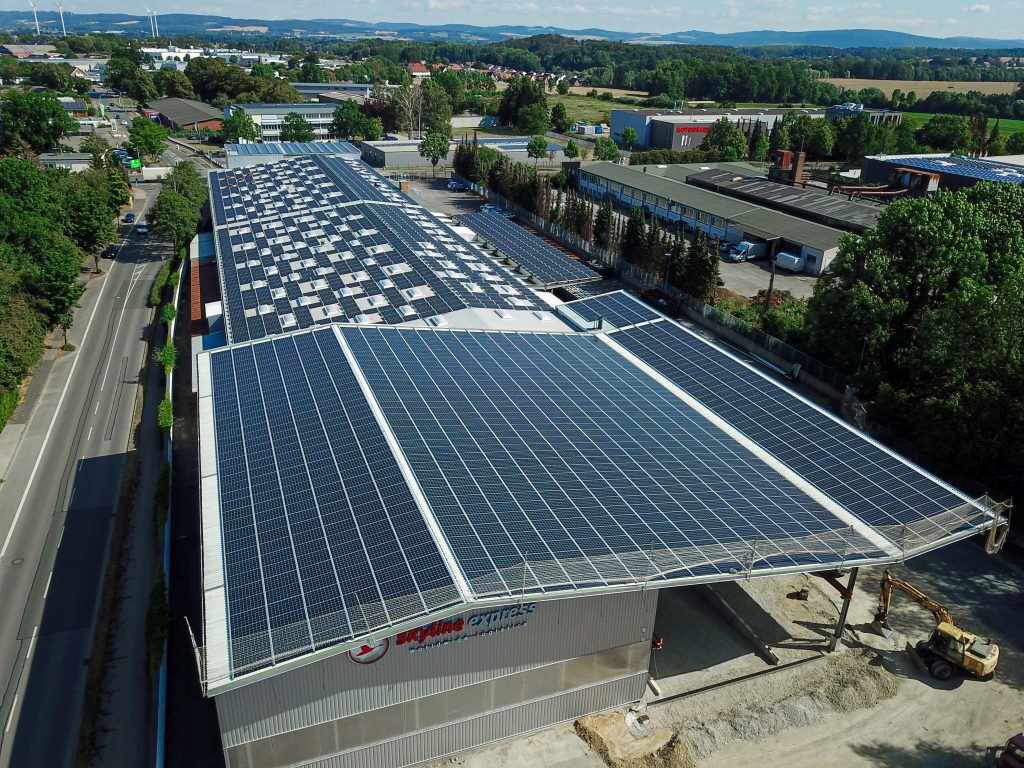
Photovoltaics for logistics meets the largest connected roof surfaces in commercial buildings. At a logistics center in Lage we have an on-roof system with around 860 kWp built.
Project at a glance
- about 860 kWp Rated power
- Occupying an uninterrupted space Large hall area
- Turnkey implementation
- Design for the site's self-sufficient power supply
- Location: Location, Lippe district, North Rhine-Westphalia
Why logistics roofs are ideal
Logistics halls are almost perfectly built for photovoltaic systems: huge rectangular areas, no structures, no shading, uniform orientation. What on a sprawling industrial site means eight separate areas is here one continuous area.
This greatly simplifies planning and reduces the installation costs per kilowatt peak. Photovoltaics for logistics Therefore, it is often more economical than the same performance on distributed roofs.
The consumption profile fits
A logistics center consumes electricity throughout the entire workday: conveyor and sorting technology, hall lighting, charging infrastructure for forklifts, and increasingly also refrigeration and air conditioning technology. This even load is well suited to the production curve of a rooftop system.
Where electric forklifts are charged, there is another advantage: the load can be charged during the peak hours when revenue is highest.
What needs to be checked for hall roofs
Large lightweight halls often have low load-bearing reserves. The Ceiling statics Therefore, this is the first point of inspection. The condition and remaining useful life of the roofing membrane are also being examined – the system is expected to last 25 years without the need to perform any maintenance work.
Scope of delivery
- Roof inspection and structural assessment
- Occupancy and string planning across the entire area
- Assembly, electrical installation and connection to the mains
- Commissioning, documentation and monitoring
Each facility is publicly registered
Photovoltaics for logistics also means reporting obligations: Every production facility is subject to reporting. Market data register of the Federal Network Agency. We will take over the registration as part of the project.
Do you operate a logistics center?
We check the structural stability of the roof and the power connection and calculate how much of your consumption the system can cover. Contact us.